Cleansed of any moral weight, suffering from excessive mathematization and abstractified principles, the discipline of economics buckles under the weight of its inheritance. The movement of giants in the field has gone from theories of moral distributions of resources under scarcity in Ricardo and Smith, to describing the fundamental principles and mathematical reality of the economy under Marshall, Keynes, Friedman, von Hayek and of course Harberger. Over time, these thinkers pushed the discipline into rigorous mathematical analysis and overly developed theories of behavior and societal optimization. Populated with many abstract principles, the discipline grew on soil worthy of disputation. In this small essay, the first salvo at my area of study, I will take aim at one flawed principle in mainstream economics: deadweight loss.
First, a small definition from researchers at the appropriately named London School of Economics: “In general economic terms, deadweight loss is a reduction in net economic benefits resulting from an inefficient allocation of resources” (Conlon, 2012). A sufficiently broad definition, the concept currently covers anything from throwing an uncooked hotdog unto the street, all the way to crooked board room deals. The definition summarizes the entire problem of the concept: whose net economic benefit, and inefficiently allocated for whom. Armed with a vague definition, it’s time to employ the economist textbook favorite: the Harberger’s triangle, displaying the phenomenon in action. Below in the poorly drawn figure (more of those to come) a simple supply and demand curve shows where the declared deadweight loss (DWL in the jargon) occurs according to current undergraduate economics textbooks. The first foundation laid in a study of the economics discipline.
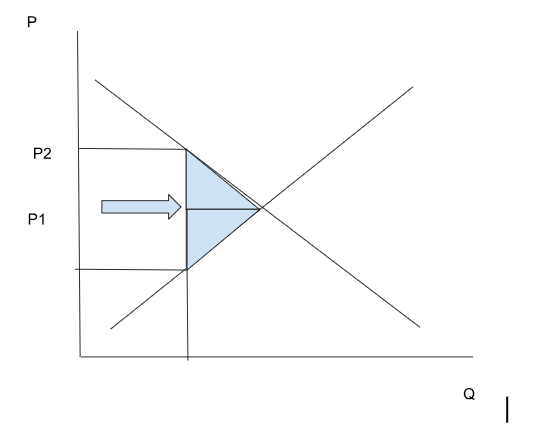
Figure 1: Deadweight Loss as described in traditional economics.
When the equilibrium price for consumers at P1 rules the day, producers make more of this good and take home more of the price consumers pay, therefore creating more net economic benefits (theoretically for both producers and consumers). Economists, without blinking, call this the socially optimal distribution. The willingness to pay of consumers, captured in the demand function, intersects the willingness to supply at that price from producers. More available and for a lower price, everybody wins. From this angle, any reduction in production of the good, say, due to a higher price, masquerades as a loss to society. A deviation from the socially optimal intersection of the lines. Fundamentally, interpreting this reallocation of productive capacity and money as DWL, creates a false impression on three levels. Causing deadweight loss to society, according to the model, are these five categories: taxation, price floors, monopoly power, trade barriers, and externalities. The complex effects of these factors on the general economy do not fit into the model demonstrated for students. Succinctly put, scope creep in the model, an unrealistic view on productivity and money supply, and indeterminate (abstract) idealistic terms create a model that tries to explain more than the inputs allow.
In essence, the triangle model of a good fails because of scope creep. The interpretation of a supply and demand model measuring DWL (Kremer, 2019; Conlon, 2012) acts as if it measures societal utility by consumption. This unidimensional view of a market as a representative for the broader economy, cannot measure social utility. Taking tariffs as an example. For mature economies with high value added goods produced, tariffs do direct harm. Infant industries and developing economies, however, can, in certain cases, benefit from trade barriers. Due to the complexity of price interlinkages, the influence of markets on each other, the productive capacity of societies, and comparative advantages in production, demonstrating the optimal outcome for society according to this single graph, is impossible. That’s only on the economic/mathematical side. The graph also does not explain the aggregate desire of the population for certain outcomes or measurements. Instead, it measures the consumption and production of a single good and the relative prices.
The graph, and your economics 101 class, claim an inefficient allocation of resources leading to a reduction in social utility, while measuring only a single market. When you dimension the market for a good in a supply and demand model, you cannot derive the societal utility of a good. Only the utility of the specific producers and consumers of that particular good. Problematically, the model considers consumption and production of megayachts without taxation as societal surplus by virtue of the existing market mechanism behind it. Absent any clear externalities in the production process. The idea that productive capacity in society goes to high value markets, regardless of societal opinions on the production of megayachts. Societal welfare, tragically lost, by implementing a tax on the sale of megayachts. Another example, because of a tax on cigarettes, you under-produce cigarettes according to the model certain consumers do not consume at their optimal demand, revenues for tobacco companies lower and their producer surplus diminishes. Even if, using a pigouvian tax to achieve the theoretically Pareto efficient state of production for cigarettes, it only describes the effect for the market for cigarettes and the utility for smokers, not societal utility. A full argument against DWL, requires looking at all the evolutions of DWL. Newer iterations of the model, strengthening the design against exogenous (outside) forces muscling their way into the theoretical world, take externalities as a force. Adding externalities into the model as a shift in the supply side (as private costs are shifted to reflect social costs), keep the model intact, while dealing with pesky people outside of the model. Morality and socially optimal distributions, exogenous (outside) the model, force their way in.
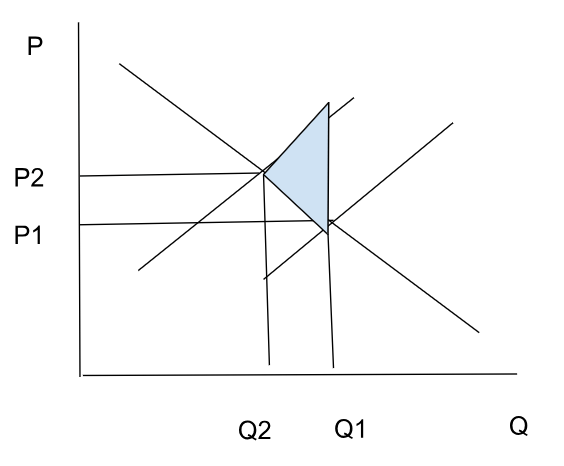
Figure 2: Externalities priced in through a tax
A good solution, within the confines of this model. The price at p1, the private marginal cost curve, causes DWL to societal utility, which should be at p2, the social marginal cost curve. In a model that only has an axis for price and quantity, though, this does not suffice to prove the model. The movements are arbitrary and theoretical, as there is no way to derive social utility from the price and the quantity. It works to illustrate a hypothetical movement in prices, but the DWL doesn’t capture “lost societal utility”, it captures a reduction in the money and productive capacity for this particular good. Without a healthy dose of nuance and explanation, the model, even with externalities, confuses more than educates. The social marginal cost (supply that society demands), an idealistic fiction, could be on either side. Is societal utility a plurality of society? A majority? Is it adjusted for social power, or relative levels of disgust? What even is the societal optimal utility? An unfortunate side effect of sanitizing the entire discussion of morality, you cannot contemplate the effects on society at large, only the single market and its consumers/producers. The model suffers scope creep, it only depicts a single market for a single good, not all of society. And social utility, therefore, cannot be derived from this graph in any meaningful way.
Point two: price linages exist, the complexity of markets neverending, and consuming or producing a good affects other commodities and society at large. Producing something demands productive capacity in society. The model fundamentally misinterprets the scale of society and all of its productive forces. To keep the argument clean, we shall cleave it in two. Production, and the money supply.
The complex puzzle of productive capacity in a society, the ability to manufacture goods and services, relies on an endless set of factors. Quick outline of what productive capacity consists of: “Our productive capacity depends on the size and skills of the workforce; the amount and quality of machines, buildings, vehicles, computers, and other physical capital that workers use; and the stock of knowledge and ideas (Tax Policy Center)”. We can add to this the general education of your population, the natural resources present, the organizational structure of extraction etc. Laying the puzzle of production depends on the global market, local advantages, and institutional inheritance. Harberger’s model, treats this as an illogical moment in time, not an evolving process.
The choices for production, in a market economy based on supply and demand, are by definition intertemporal. In an economy that changes over time, production demand and supply react to shocks and anticipate the future. True deadweight loss, or societal loss, only occurs if no time passes and no one adjusts, so that the productive capacity of society evaporates. Taking cigarettes again. An approaching tax leads to fervent lobbying, money and productive capacity flows to D.C. to overturn the legislation. Lobbying fails, and a year later, the tax on cigarettes goes through. Anticipating the tax, they cut lobbyists, two production locations, and layoff workers. D.C. uses the tax to fund teachers and infrastructure development in the area. The two factories are bought up and retooled to print magazines.
Once you encounter the real world, intertemporality proves vital to the allocation of societal production. The complete economy, incredibly complex and interlinked, can’t be predicted by a graph for the market of cigarettes. It’s not found in a snapshot. Fewer hospital visits, lower rate of smokers. Societal loss is encountered in manufacturing jobs, lost export potential, and lobbyists in need of a new crusade to latch onto. Evolving productive capacity allocation in society and its complexity, are not captured at all in this model. It’s static.
Then there is the system of allocating productive capacity: money. Friedman, for his many flaws and deeply ideological political takes, makes the case that the money supply of society connects different financial streams and markets (Friedman, 1967). When outlining his opposition to higher taxation, he undercuts the traditional stance against taxation as recession inducing by: “True, higher taxes would leave taxpayers with less to spend. But this is only part of the story. If government spending were unchanged, more of it would now be financed by the higher taxes, and the government would have to borrow less. The individuals, banks, corporations or other lenders from whom the government would have borrowed now have more left to spend or to lend to others–and this extra amount is precisely equal to the reduction in the amount available to them and others as taxpayers (Friedman, 1967).” His italics, not mine.
Simplifying: the pool of money in society does not diminish by taxation. The money that could have been spent on producing cigarettes (sticking with the example) does not evaporate, it is reallocated. Quoting Friedman one last time: “To have a significant impact on the economy, a tax increase must somehow affect monetary policy–the quantity of money and its rate of growth. It clearly need not have any such effect (Friedman, 1967).” And although it can affect prices and thereby inflation, the idea of DWL sketches an incomplete picture of money supply and monetary models. With the money supply stable under taxation, the long run effects on total productive capacity are not derived. They can be marginal, negative, or maybe positive. We don’t know.
Mostly focusing on taxation or tariffs so far, similar problems emerge with the other causes of DWL in the model. The effect of a price ceiling limits activity in that market, but fails to predict the social optimum. Productive capacity and money flows into other sectors. The model and orthodoxy then declares that a misallocation of resources and a reduction in overall social welfare follows. A silent ought derived from an is, in a field allergic to moral theory. The actual outcome, unclear. Productive capacity, mostly unchanged except for this sector, flows into adjacent or high demand sectors over time. In fact, the capital investments, accumulated knowledge, networking power, and institutional inheritance of the tobacco factories seem the only ones to lose on the production side. More evidence of scope creep, only this specific sector sees less economic activity. The effect on society at large, underivable from this model.
The graph below puts two fictional, theoretical markets next to each other. The one on the left describing the production of cigarettes, the right one a fictional addition of money into all other production (regardless of sector or market). The arrow indicates the reallocation of productive capacity into another sector. There is no deadweight loss, there is reallocated productive capacity and money into other sectors. In theory, this could, by a minuscule fraction, impact the supply curve in other markets due to investors, and by a similarly minuscule fraction, change the demand curve for all other goods in a direction. The direction of demand, dependent on many factors, moves in many directions. I cannot stress this enough, the image illustrates only the tiniest marginal movements.
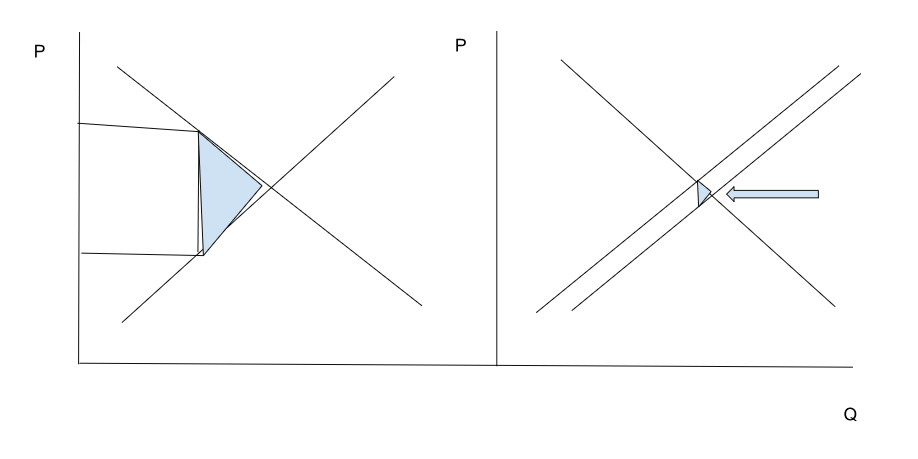
Figure 3: reallocation of productive capacity into other sectors.
The graph proves nothing, beyond the fact that any troglodyte can draw a graph and strong conclusions from it.
The DWL is not an L, it’s a reallocation mechanism that creates gains for other markets and public utilities in society. By lowering the producer surplus and consumption of megayachts and cigarettes, more labor flows into building freight ships and pencils, educating the next generation on the theory of DWL, and building healthcare institutions. In orthodox economics, deadweight loss is the loss of societal economic welfare due to production/consumption of a good at a quantity where marginal benefit (to society) does not equal marginal cost (to society). So far, it seems only to demonstrate the economic welfare due to consumption of a good at a quantity where marginal benefit (to individual consumers) does not equal marginal cost (to producers).
The last point, a personal gripe, deserves a small section. Surplus and utility, as idealistic terms describing society at large, go undefined and not useful. The concrete gains and losses hide, obscured in vague terms. With monopoly power setting the price higher than their costs demand, they get more money, for fewer inputs. Higher producer surplus means, therefore, that producers get higher margins. In turn they’re able, with this money, to influence further productive capacity allocation in society. Consumer surplus means the inverse. The model, due to limitations mentioned above, cannot fundamentally tell you the social utility, it can tell you the monetary gains and production levels of a particular market, for a particular good.
Teaching students of the economy that DWL occurs, with a model of deriving a socially optimal production of a good, sets the discipline up for moral failure. Instead of conversing on the moral desirability of production and consumption, the optimal usage and distribution of resources in our society, and appreciation for the complexity of the economy, we distill in students an adverse reaction to taxation, price floors, trade barriers (including opium), and monopoly power (including natural monopolies such as SOE for rail and gas). The economy is complex, understanding it requires nuance and depth. Limit your model to the appropriate scope, or take morality of distribution as a significant part of your model.
When taking a supply and demand model for a single market, explain that it models a single market for a good well, with supply or demand shocks. Open the conversation to the five causes of market movements for reallocating societal productive capacity and money. Trust that students can handle the vague complexity of economics.
Those of you not blessed with a degree in math light (read: economics), weigh the words objectively and form an opinion based on your understanding of productive capacity, money supply, and my beautiful graphs. The economists among you though, require more thorough macroeconomic convincing. Unfortunately, time for disappointment. Another essay deals more in depth with theories on money, allocation of productive capacity, and humanity as a moral, economic agent.
Sources:
– Assessing the Deadweight Loss Associated with Public Investment in Further Education and Skills; Gavan Conlon, Pietro Patrignani and Annabel Litchfield / 2012
– Worst-case deadweight loss: Theory and disturbing real-world implications; Michael Kremer | Christopher Snyder | Albert Chen / 26 Mar 2019
– “Higher Taxes? No” Milton Friedman Newsweek, 23


Leave a Reply